

Music Royalties in Canada: The 2026 Deep Dive for Artists, Labels & Collectors
Music royalties in Canada can feel like solving a puzzle blindfolded. You know there's money floating around out there from your songs, but figuring out how to actually collect it? That's where things get tricky.
Whether you're an indie artist who just released your first single or a label trying to maximize revenue streams, understanding Canada's royalty system is crucial. The good news? It's not as complicated as it seems once you know the basics.
The Big Picture: What Are Music Royalties?
Music royalties are payments made to rights holders when their music gets used. Think of it as rent for your creative property. Every time someone plays your song on the radio, streams it on Spotify, uses it in a commercial, or plays it at a coffee shop, money gets generated.
In Canada, several organizations collect these payments and distribute them to artists, songwriters, composers, and publishers. The key is making sure you're registered with the right ones.
Types of Royalties in Canada
Performance Royalties
These are the bread and butter of music royalties. Performance royalties get triggered whenever your music gets played publicly - radio, streaming services, live venues, restaurants, gyms, you name it.
In Canada, SOCAN (Society of Composers, Authors and Music Publishers of Canada) handles most performance royalties. They collect money from businesses that play music and distribute it to rights holders.
For 2026, SOCAN has updated several tariffs. Online music services now pay 10.3% of gross revenue (or 5.9% for music video-only services), with a minimum fee of 0.13¢ per stream. That might sound small, but it adds up fast across millions of streams.
Mechanical Royalties
These get paid when your music gets reproduced - whether that's physical copies like vinyl and CDs, or digital downloads. Streaming services also pay mechanical royalties, though the rates are different.
MROC (Musicians' Rights Organization Canada) distributes the performer's share of neighbouring rights and private copying royalties to over 10,000 musicians.
Neighbouring Rights
This is where it gets interesting. Neighbouring rights are for the actual recording, not the song itself. So if you're the artist who performed on a track, you get neighbouring rights. If you wrote the song, you get performance royalties through SOCAN.
ARTISTI manages remuneration rights for over 5,000 performers, while ACTRA RACS ensures session musicians, background performers, and featured vocalists get paid across all genres.
Synchronization Royalties
Sync royalties happen when your music gets paired with visual media - movies, TV shows, commercials, video games, YouTube videos. These are often negotiated directly and can be significant paydays for artists.
Who Gets Paid What?
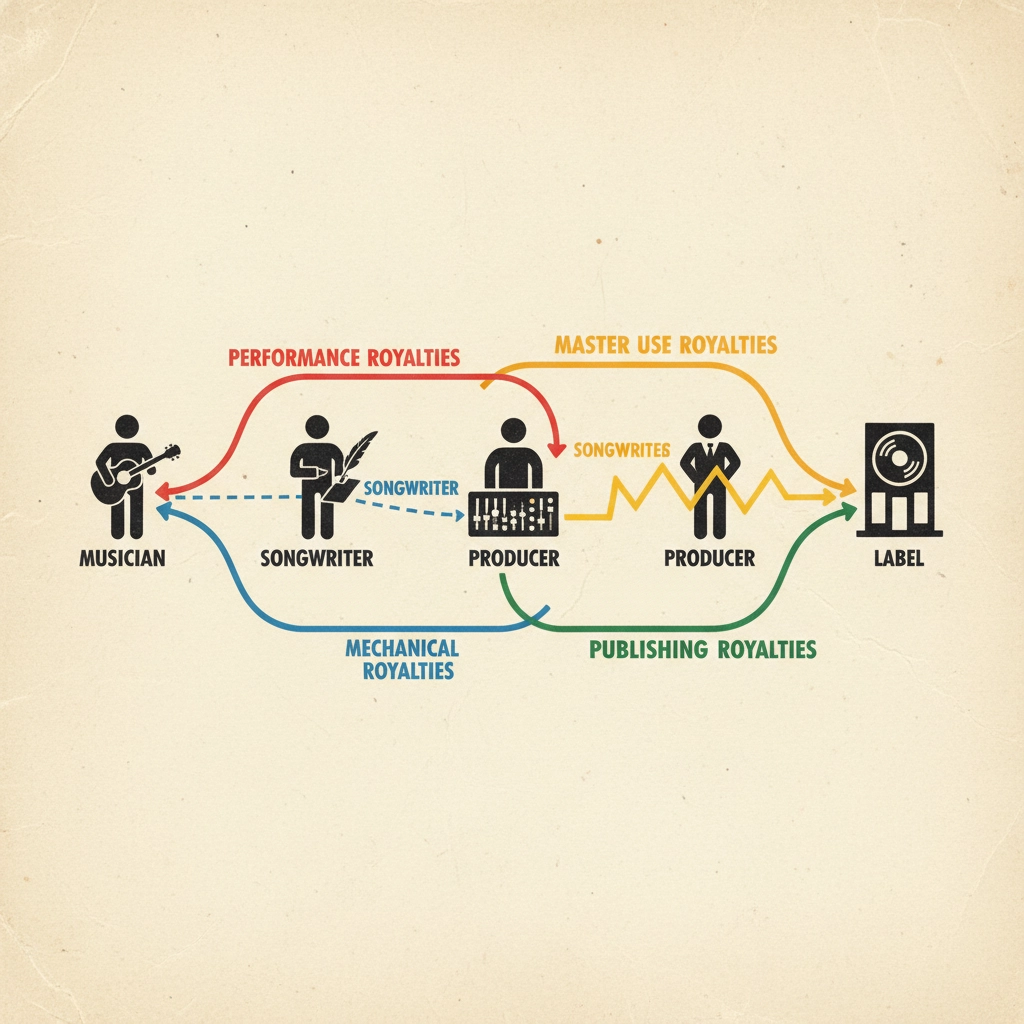
Here's where things get layered. Multiple people can earn money from a single song:
Songwriters and Publishers get performance and mechanical royalties through SOCAN. If you wrote the song, you're entitled to these.
Recording Artists get neighbouring rights through MROC, ARTISTI, or ACTRA RACS, depending on their role.
Producers often negotiate points on a recording, which means they get a percentage of certain royalties.
Record Labels typically take a cut of mechanical royalties and neighbouring rights, depending on your contract.
The split depends on your agreements. Independent artists who write and perform their own music can collect from multiple streams, which is why going indie can be financially attractive.
The ISRC Code: Your Music's Social Insurance Number
This is crucial: Every recording needs an ISRC (International Standard Recording Code). Think of it like a social insurance number for your song. Without it, collecting societies can't properly track your music or pay you.
An ISRC looks like this: CA-ABC-12-34567. It identifies the specific recording, not just the song. If you record an acoustic version of the same song, that needs its own ISRC.
You can get ISRC codes through various distributors like DistroKid or CD Baby, or directly from Music Canada. Don't skip this step - it's the difference between getting paid and watching your royalties disappear into the void.
Canadian Collecting Societies: Who Does What
SOCAN is your main stop for performance and synchronization royalties. They represent over 175,000 Canadian and international songwriters, composers, and publishers.
MROC focuses on the performer's share of neighbouring rights and private copying levies. They work with featured artists, session musicians, and background vocalists.
ARTISTI specializes in neighbouring rights for performers, particularly focusing on equitable remuneration.
ACTRA RACS ensures all types of recording artists get their neighbouring rights, from lead vocalists to horn sections.

How to Actually Get Paid: The Action Steps
1. Register Everything
Join SOCAN if you write songs. Sign up with MROC, ARTISTI, or ACTRA RACS if you perform. This isn't optional - these organizations can't pay you if they don't know you exist.
2. Get Your ISRC Codes Sorted
Every single recording needs its own ISRC. Set up a system to track these codes because you'll need them for everything from streaming distribution to royalty claims.
3. Register Your Works
Don't just join the collecting societies - actively register your songs and recordings with them. Provide detailed information about who wrote what, who performed what, and what percentage everyone owns.
4. Track Your Music Usage
Keep records of where your music gets played. Radio plays, streaming platforms, live performances, sync placements - document everything. This helps when there are discrepancies in payments.
5. Understand the Timeline
Royalties don't appear overnight. Performance royalties can take 6-18 months to show up. Streaming royalties are faster but still take several months. Plan your cash flow accordingly.
Common Mistakes That Cost You Money
Not registering with collecting societies. You can't collect what you're not signed up for.
Forgetting about neighbouring rights. Many indie artists focus on SOCAN but ignore MROC and ARTISTI, leaving money on the table.
Poor metadata. Spelling errors, missing information, or incorrect credits can delay or prevent payments.
Not claiming international royalties. Your music might be earning money in other countries. SOCAN has reciprocal agreements with collecting societies worldwide.
Ignoring small venues. That coffee shop playing your music might seem insignificant, but it adds up across thousands of small businesses.
The Business Reality for 2026
Canadian artists earned nearly $460 million CAD from Spotify alone in 2024, with 92% coming from international listeners. This shows the global potential for Canadian music.
Audio streaming now accounts for 79% of recorded music revenue in Canada. The shift is clear - streaming is where the money is, but traditional performance venues still matter.
For context, recorded music revenue in Canada grew from $397 million CAD in 2014 to $909 million CAD in 2024 - a 129% increase. The pie is getting bigger, but competition is fierce.
Making It Work for Independent Artists
The beauty of Canada's royalty system is that it doesn't discriminate based on label size. Independent artists have the same access to collecting societies as major label acts.
However, you need to be proactive. Major labels have whole departments handling royalty collection. As an indie artist, this responsibility falls on you.
Consider working with a music publisher or rights management company if the administrative burden becomes overwhelming. They'll take a percentage, but they might collect more than you would on your own.
Remember, every stream counts, every radio play matters, and every live performance can generate royalties. Understanding this system isn't just about getting paid for past work - it's about maximizing revenue from everything you create moving forward.
The Canadian music royalty landscape in 2026 offers multiple revenue streams for informed artists. The key is understanding what's available, registering properly, and staying on top of the administrative details that turn your creative work into sustainable income.
